
US ECONOMY
 | |  | |  | |  | |  |
THE 16 DAYS THAT SHOOCK THE US ECONOMY IN SEPTEMBER, 2008.
A shocking series of events that forever changed the financial markets.
When banks don't lend to each other and the credit system gets backed up, consumers have a hard time getting a
loan to buy a home or car, small businesses can't expand and employees are at risk of losing their jobs.
There are major investors, and we mean really big ones: countries, sovereign wealth funds, pension funds, hedge
funds and, of course, banks. When credit is flowing smoothly, they send money between each other. They also loan
money to corporations.
A shocking series of events that forever changed the financial markets.
When banks don't lend to each other and the credit system gets backed up, consumers have a hard time getting a
loan to buy a home or car, small businesses can't expand and employees are at risk of losing their jobs.
There are major investors, and we mean really big ones: countries, sovereign wealth funds, pension funds, hedge
funds and, of course, banks. When credit is flowing smoothly, they send money between each other. They also loan
money to corporations.
Monday, Sept. 22 - Second thoughts
On Monday morning Wall Street woke up to a new world order, and it wasn't happy. Late
Sunday night, the news emerged that Goldman Sachs and Morgan Stanley would change
their status to bank holding companies, giving them access to Federal funds to help buoy
them, and effectively bringing to an end Wall Street as we know it.
A day after its status change, Morgan Stanley announced it agreed to sell up to a fifth of the
company to Mitsubishi UFJ Financial Group, one of Japan's largest banks.
Meanwhile, news of the massive federal bailout that was greeted with relief on Friday,
sending the Dow up 369 points, began to sink in, and questions emerged. Taxpayers
were enraged that Wall Street fat cats would get a handout while ordinary citizens were left
to flounder. Members of Congress on both sides of the aisle began gearing up for
Tuesday's hearing, expressing concern at the notion of handing Treasury a blank check,
and at the plan's lack of oversight.
The markets expressed their own dismay, with the Dow closing down 373 points as
investors fretted about the bailout. The dollar was crushed, posting its biggest single-day
drop in four years as traders absorbed just how diluted the bailout would leave the U.S.
currency. Meanwhile, oil surged more than $25, its biggest dollar gain ever, to $130 a
barrel before settling at $120 as big investors scrambled to fill obligations as the October
contract expired.
On Monday morning Wall Street woke up to a new world order, and it wasn't happy. Late
Sunday night, the news emerged that Goldman Sachs and Morgan Stanley would change
their status to bank holding companies, giving them access to Federal funds to help buoy
them, and effectively bringing to an end Wall Street as we know it.
A day after its status change, Morgan Stanley announced it agreed to sell up to a fifth of the
company to Mitsubishi UFJ Financial Group, one of Japan's largest banks.
Meanwhile, news of the massive federal bailout that was greeted with relief on Friday,
sending the Dow up 369 points, began to sink in, and questions emerged. Taxpayers
were enraged that Wall Street fat cats would get a handout while ordinary citizens were left
to flounder. Members of Congress on both sides of the aisle began gearing up for
Tuesday's hearing, expressing concern at the notion of handing Treasury a blank check,
and at the plan's lack of oversight.
The markets expressed their own dismay, with the Dow closing down 373 points as
investors fretted about the bailout. The dollar was crushed, posting its biggest single-day
drop in four years as traders absorbed just how diluted the bailout would leave the U.S.
currency. Meanwhile, oil surged more than $25, its biggest dollar gain ever, to $130 a
barrel before settling at $120 as big investors scrambled to fill obligations as the October
contract expired.
Wednesday, Sept. 24 - Closer to a deal
Well before the markets opened, the Fed announced that it would flood the system with
even more cash, making $30 billion available to the central banks of Australia, Denmark,
Norway and Sweden.
Back in Washington, the debate about the Bush administration's proposed $700 billion
bailout raged on, this time in front of the House Financial Services Committee, which
grilled Treasury Secretary Henry Paulson and Federal Reserve Chairman Ben Bernanke
over the plan's details.
Progress was reported toward an agreement. Paulson agreed that the bill should curb
executive compensation at firms that sign up for the rescue plan, one of the Democrats'
key demands. But he remained opposed to allowing bankruptcy judges to change
mortgage terms because it's "inconsistent with what we're trying to do, which is increase
the flow of funds."
Still under discussion was whether the government should get an equity stake in
companies that participate in the plan, and whether the government will encourage
foreclosure prevention for the troubled loans it purchases.
Members of Congress demanded to know how they could justify a bailout to their enraged
constituents.
President Bush made a televised speech Wednesday night to make the case for his plan.
"We are in the midst of a serious financial crisis," he said. "Our entire economy is in
danger."
Well before the markets opened, the Fed announced that it would flood the system with
even more cash, making $30 billion available to the central banks of Australia, Denmark,
Norway and Sweden.
Back in Washington, the debate about the Bush administration's proposed $700 billion
bailout raged on, this time in front of the House Financial Services Committee, which
grilled Treasury Secretary Henry Paulson and Federal Reserve Chairman Ben Bernanke
over the plan's details.
Progress was reported toward an agreement. Paulson agreed that the bill should curb
executive compensation at firms that sign up for the rescue plan, one of the Democrats'
key demands. But he remained opposed to allowing bankruptcy judges to change
mortgage terms because it's "inconsistent with what we're trying to do, which is increase
the flow of funds."
Still under discussion was whether the government should get an equity stake in
companies that participate in the plan, and whether the government will encourage
foreclosure prevention for the troubled loans it purchases.
Members of Congress demanded to know how they could justify a bailout to their enraged
constituents.
President Bush made a televised speech Wednesday night to make the case for his plan.
"We are in the midst of a serious financial crisis," he said. "Our entire economy is in
danger."
Tuesday Sept. 23 - A spirited debate
Treasury Secretary Henry Paulson and Federal Reserve chairman Ben Bernanke went
before the Senate Banking Committee to defend the Bush administration's bailout plan
in a spirited debate. The two faced strong criticism from both Democrats and
Republicans who argued that the program needed more restrictions.
Sen. Richard Shelby of Alabama, the top Republican on the committee, said the
government's previous efforts to save mortgage giants Fannie Mae and Freddie Mac, as
well Bear Stearns, show the limitations on attempts to fix markets.
"You can't assure us this will work because you thought the other plans would work,"
Shelby said.
Sen. Jim Bunning, a conservative Republican from Kentucky, said that he could not
support the proposal.
"It will not help struggling homeowners pay their mortgages. It will not bring a halt to the
slide in home prices," Bunning said. "This massive bailout is not a solution. It's
financial socialism and it's un-American."
Lawmakers were also concerned about the program's risk to taxpayers. But Bernanke
stressed that most or even all of what the government spends to buy the assets would
be recovered when the assets are eventually sold.
Drafts of counterproposals emerged from both chambers, led by Chris Dodd, D-Conn.,
in the Senate and Barney Frank, D-Mass., in the House. They want the government to
get an equity stake in the companies it helps; more assistance for those at risk of
foreclosure; more oversight of the program; and curbs on compensation of executives
of participating companies.
There was also some good news. After the market close, Goldman Sachs announced
that it will raise capital by selling $5 billion of preferred stock to Warren Buffett's
Berkshire Hathaway.
Treasury Secretary Henry Paulson and Federal Reserve chairman Ben Bernanke went
before the Senate Banking Committee to defend the Bush administration's bailout plan
in a spirited debate. The two faced strong criticism from both Democrats and
Republicans who argued that the program needed more restrictions.
Sen. Richard Shelby of Alabama, the top Republican on the committee, said the
government's previous efforts to save mortgage giants Fannie Mae and Freddie Mac, as
well Bear Stearns, show the limitations on attempts to fix markets.
"You can't assure us this will work because you thought the other plans would work,"
Shelby said.
Sen. Jim Bunning, a conservative Republican from Kentucky, said that he could not
support the proposal.
"It will not help struggling homeowners pay their mortgages. It will not bring a halt to the
slide in home prices," Bunning said. "This massive bailout is not a solution. It's
financial socialism and it's un-American."
Lawmakers were also concerned about the program's risk to taxpayers. But Bernanke
stressed that most or even all of what the government spends to buy the assets would
be recovered when the assets are eventually sold.
Drafts of counterproposals emerged from both chambers, led by Chris Dodd, D-Conn.,
in the Senate and Barney Frank, D-Mass., in the House. They want the government to
get an equity stake in the companies it helps; more assistance for those at risk of
foreclosure; more oversight of the program; and curbs on compensation of executives
of participating companies.
There was also some good news. After the market close, Goldman Sachs announced
that it will raise capital by selling $5 billion of preferred stock to Warren Buffett's
Berkshire Hathaway.
Sunday, Sept. 21 - The end of an era
A week after the collapse of Lehman Brothers and the sale of Merrill Lynch put the cogs
in motion, Secretary Paulson was on the Sunday morning talk shows pitching his $700
billion bailout proposal.
"The biggest help we can give the American people is to stabilize our financial system
right now and to prevent the system from clogging up, because if it does clog up, this is
going to have an adverse effect on people's abilities to get jobs, on their budgets, on
their retirement savings, on lending for small businesses," Paulson said on ABC's
"This Week."
Still, the Democrats said the plan lacked necessary safeguards for taxpayers and
homeowners.
"We will not simply hand over a $700 billion blank check to Wall Street and hope for a
better outcome," Speaker Pelosi said.
But even as the details of the bailout were being hammered out, there were yet more
staggering developments in the crisis, effectively ending an era on Wall Street.
Late in the day came the news that Goldman Sachs and Morgan Stanley, the two
remaining independent Wall Street investment banks, would be converted into
traditional bank holding companies, which will increase their regulation by the federal
government.
The move was designed to prevent the storied brokerage firms from suffering the same
fate as Lehman and Bear Stearns, by giving them access to cheaper, and more stable
sources of funding from the retail banking business and from the Federal Reserve.
A week after the collapse of Lehman Brothers and the sale of Merrill Lynch put the cogs
in motion, Secretary Paulson was on the Sunday morning talk shows pitching his $700
billion bailout proposal.
"The biggest help we can give the American people is to stabilize our financial system
right now and to prevent the system from clogging up, because if it does clog up, this is
going to have an adverse effect on people's abilities to get jobs, on their budgets, on
their retirement savings, on lending for small businesses," Paulson said on ABC's
"This Week."
Still, the Democrats said the plan lacked necessary safeguards for taxpayers and
homeowners.
"We will not simply hand over a $700 billion blank check to Wall Street and hope for a
better outcome," Speaker Pelosi said.
But even as the details of the bailout were being hammered out, there were yet more
staggering developments in the crisis, effectively ending an era on Wall Street.
Late in the day came the news that Goldman Sachs and Morgan Stanley, the two
remaining independent Wall Street investment banks, would be converted into
traditional bank holding companies, which will increase their regulation by the federal
government.
The move was designed to prevent the storied brokerage firms from suffering the same
fate as Lehman and Bear Stearns, by giving them access to cheaper, and more stable
sources of funding from the retail banking business and from the Federal Reserve.
Saturday, Sept. 27 - Bailout breakthrough
After a late-night bargaining session, negotiators resumed talks Saturday afternoon over
the $700 billion bailout plan with fewer than a dozen "unresolved issues" remaining,
according to a senior administration official.
Signs of progress appeared early on from both Republican and Democratic lawmakers
who said they were shooting for a deal by Sunday.
But a group of House Republicans said they would not be held to any "artificial timelines."
Still, they remained confident a deal could be reached that helped the financial system but
protected taxpayers.
Negotiators had talked by phone with billionaire investor Warren Buffett for guidance, and
according to two sources, he warned if congress did not act, the nation would face the
"biggest financial meltdown in American history."
Finally after midnight, congressional leaders said they reached a tentative deal and were
aiming to craft final legislation by Sunday evening - in time for the start of financial markets
around the world.
Key points included who would oversee the program, when the money would go out,
government stakes in companies to mitigate taxpayer losses and curbs on executive
compensation.
After a late-night bargaining session, negotiators resumed talks Saturday afternoon over
the $700 billion bailout plan with fewer than a dozen "unresolved issues" remaining,
according to a senior administration official.
Signs of progress appeared early on from both Republican and Democratic lawmakers
who said they were shooting for a deal by Sunday.
But a group of House Republicans said they would not be held to any "artificial timelines."
Still, they remained confident a deal could be reached that helped the financial system but
protected taxpayers.
Negotiators had talked by phone with billionaire investor Warren Buffett for guidance, and
according to two sources, he warned if congress did not act, the nation would face the
"biggest financial meltdown in American history."
Finally after midnight, congressional leaders said they reached a tentative deal and were
aiming to craft final legislation by Sunday evening - in time for the start of financial markets
around the world.
Key points included who would oversee the program, when the money would go out,
government stakes in companies to mitigate taxpayer losses and curbs on executive
compensation.
Friday, Sept. 26 - Back to the bargaining table
Wall Street was a grim scene Friday morning. Stocks were looking at a tough session
after news of Washington Mutual's collapse the night before and fears that partisan
bickering would further delay the Bush administration's $700 billion financial rescue plan.
Capitol Hill negotiators returned to the bargaining table Friday to work on details of the
plan, while President Bush and leading lawmakers offered assurances that Congress
and the administration would hammer out a deal.
Stocks stumbled through much of the day, but they rallied toward the end of the session
on news that bailout talks has resumed, with Republicans and Democrats working
towards a compromise. Investors positioned themselves for a Monday rally, on the hopes
that a deal would be made by Sunday.
For a time, the first presidential debate that was scheduled for Friday night hung in the
balance. Sen. John McCain, R-Ariz., said that working on the bailout was more important
than campaigning, and he decided to return to Capitol Hill to help work on a plan. But Sen.
Barack Obama, D-Ill., said there was no need to cancel or postpone the debate.
In the end, the candidates decided to go ahead and face off at the University of
Mississippi, where the nation's economic crisis took center stage early on.
Wall Street was a grim scene Friday morning. Stocks were looking at a tough session
after news of Washington Mutual's collapse the night before and fears that partisan
bickering would further delay the Bush administration's $700 billion financial rescue plan.
Capitol Hill negotiators returned to the bargaining table Friday to work on details of the
plan, while President Bush and leading lawmakers offered assurances that Congress
and the administration would hammer out a deal.
Stocks stumbled through much of the day, but they rallied toward the end of the session
on news that bailout talks has resumed, with Republicans and Democrats working
towards a compromise. Investors positioned themselves for a Monday rally, on the hopes
that a deal would be made by Sunday.
For a time, the first presidential debate that was scheduled for Friday night hung in the
balance. Sen. John McCain, R-Ariz., said that working on the bailout was more important
than campaigning, and he decided to return to Capitol Hill to help work on a plan. But Sen.
Barack Obama, D-Ill., said there was no need to cancel or postpone the debate.
In the end, the candidates decided to go ahead and face off at the University of
Mississippi, where the nation's economic crisis took center stage early on.
Thursday, Sept. 25 - Deal, or no deal
Early in the afternoon, key lawmakers announced that they had reached an agreement on
a set of principles for legislation in order to enact the Bush administration's proposal.
Markets soared as investors believed the bill would soon be signed.
The proposal would help homeowners, curb executive pay packages at participating firms
and provide oversight of Treasury's actions. The Treasury would receive the $700 billion in
installments and would also get an equity stake in the companies being helped by the
bailout.
A few hours later, when Congressional leaders and presidential nominees Barack
Obama and John McCain met with President Bush and Secretary Paulson at the White
House, the negotiations broke down, revealing a split between Democrats and House
Republicans.
House Republicans issued a statement of economic rescue principles that called for Wall
Street to fund the recovery by injecting private capital - not taxpayer dollars - into the
financial markets. The plan also called for participating firms to disclose the value of the
mortgage assets on their books, ending Fannie Mae and Freddie Mac's securitization of
"unsound mortgages," reviewing the performance of the credit rating agencies, having the
SEC audit failed companies to ensure their financial standing was accurately portrayed,
and creating a panel to make recommendations for reforming the financial industry by
year's end.
Late-night talks between lawmakers and Treasury Secretary Henry Paulson failed to end
in agreement, shattering any hopes of a clean, bipartisan legislative effort, and putting in
jeopardy chances of passing a bill by the end of the week.
Then, in another stunning event, Washington Mutual collapsed late Thursday night,
marking the biggest bank failure in history. But after the troubled thrift was seized by the
FDIC, federal regulators helped orchestrate a deal in which JPMorgan Chase paid $1.9
billion for WaMu's assets.
Early in the afternoon, key lawmakers announced that they had reached an agreement on
a set of principles for legislation in order to enact the Bush administration's proposal.
Markets soared as investors believed the bill would soon be signed.
The proposal would help homeowners, curb executive pay packages at participating firms
and provide oversight of Treasury's actions. The Treasury would receive the $700 billion in
installments and would also get an equity stake in the companies being helped by the
bailout.
A few hours later, when Congressional leaders and presidential nominees Barack
Obama and John McCain met with President Bush and Secretary Paulson at the White
House, the negotiations broke down, revealing a split between Democrats and House
Republicans.
House Republicans issued a statement of economic rescue principles that called for Wall
Street to fund the recovery by injecting private capital - not taxpayer dollars - into the
financial markets. The plan also called for participating firms to disclose the value of the
mortgage assets on their books, ending Fannie Mae and Freddie Mac's securitization of
"unsound mortgages," reviewing the performance of the credit rating agencies, having the
SEC audit failed companies to ensure their financial standing was accurately portrayed,
and creating a panel to make recommendations for reforming the financial industry by
year's end.
Late-night talks between lawmakers and Treasury Secretary Henry Paulson failed to end
in agreement, shattering any hopes of a clean, bipartisan legislative effort, and putting in
jeopardy chances of passing a bill by the end of the week.
Then, in another stunning event, Washington Mutual collapsed late Thursday night,
marking the biggest bank failure in history. But after the troubled thrift was seized by the
FDIC, federal regulators helped orchestrate a deal in which JPMorgan Chase paid $1.9
billion for WaMu's assets.
Sunday, Sept. 28 - Hard-won agreement
After days of intense negotiations on Capitol Hill, lawmakers unveiled the bailout's final
legislation late Sunday afternoon. The bill calls for Treasury to buy as much as $700 billion
in troubled mortgages and other assets from financial institutions, which was what
Treasury Secretary Henry Paulson proposed when he first announced the plan on Sept. 18.
But the bill, which will go to the House for a vote on Monday and to the Senate on
Wednesday, contains provisions addressing some of lawmakers' concerns about the
burden that the bailout could have on taxpayers.
The $700 billion would be disbursed in stages, with $250 billion made available
immediately for the Treasury's use. And although experts expect Treasury to be able to sell
the troubled assets for more than they bought them for, the bill says that the president
must propose legislation to recoup money from the financial industry if the rescue plan
results in net losses to taxpayers at the end of five years.
In addition, Treasury would be allowed to take ownership stakes in participating
companies. The legislation also requires the government, as the owner of mortgage
loans, to try to modify more troubled loans. There will be limits on executive compensation
for participating companies, and two oversight board established to guide the program.
As history was unfolding in Washington, there was yet more drama developing. In Europe,
Dutch-Belgian bank and insurance giant Fortis NV received a 11.2 billion euro ($16.4
billion) lifeline by authorities in Belgium, the Netherlands and Luxembourg. And on Wall
Street, a bidding war erupted for the troubled bank Wachovia between banking giants
Citigroup and Wells Fargo.
After days of intense negotiations on Capitol Hill, lawmakers unveiled the bailout's final
legislation late Sunday afternoon. The bill calls for Treasury to buy as much as $700 billion
in troubled mortgages and other assets from financial institutions, which was what
Treasury Secretary Henry Paulson proposed when he first announced the plan on Sept. 18.
But the bill, which will go to the House for a vote on Monday and to the Senate on
Wednesday, contains provisions addressing some of lawmakers' concerns about the
burden that the bailout could have on taxpayers.
The $700 billion would be disbursed in stages, with $250 billion made available
immediately for the Treasury's use. And although experts expect Treasury to be able to sell
the troubled assets for more than they bought them for, the bill says that the president
must propose legislation to recoup money from the financial industry if the rescue plan
results in net losses to taxpayers at the end of five years.
In addition, Treasury would be allowed to take ownership stakes in participating
companies. The legislation also requires the government, as the owner of mortgage
loans, to try to modify more troubled loans. There will be limits on executive compensation
for participating companies, and two oversight board established to guide the program.
As history was unfolding in Washington, there was yet more drama developing. In Europe,
Dutch-Belgian bank and insurance giant Fortis NV received a 11.2 billion euro ($16.4
billion) lifeline by authorities in Belgium, the Netherlands and Luxembourg. And on Wall
Street, a bidding war erupted for the troubled bank Wachovia between banking giants
Citigroup and Wells Fargo.
Monday, Sept. 29 - Crushing defeat
In a stunning development, the House of Representatives voted down the $700 billion
financial bailout plan by a 228-205 margin after working days to hash out an agreement.
Two-thirds of Republicans and one-third of Democrats voted against the measure.
The defeat shocked the world, following pledges by leaders of both parties to work
together to avert economic disaster. Markets in the U.S. and abroad reacted with alarm.
The Dow plunged 777 points, its largest one-day point drop ever, while Japan's Nikkei lost
4%, Australia's markets fell 4.3% and Taiwan's stocks retreated 3.6%.
It was unclear how Congress would proceed with the legislation.
Earlier in the day, Citibank agreed to buy Wachovia bank's assets for $2.2 billion in an
FDIC-arranged deal, while Lehman Brothers sold its Neuberger Berman investment
management unit to a pair of private-equity firms for $2.15 billion.
Additionally, a federal grand jury launched an investigation into accounting and disclosure
issues at Fannie Mae and Freddie Mac, the mortgage finance giants that were taken over
by the government earlier this month.
In a stunning development, the House of Representatives voted down the $700 billion
financial bailout plan by a 228-205 margin after working days to hash out an agreement.
Two-thirds of Republicans and one-third of Democrats voted against the measure.
The defeat shocked the world, following pledges by leaders of both parties to work
together to avert economic disaster. Markets in the U.S. and abroad reacted with alarm.
The Dow plunged 777 points, its largest one-day point drop ever, while Japan's Nikkei lost
4%, Australia's markets fell 4.3% and Taiwan's stocks retreated 3.6%.
It was unclear how Congress would proceed with the legislation.
Earlier in the day, Citibank agreed to buy Wachovia bank's assets for $2.2 billion in an
FDIC-arranged deal, while Lehman Brothers sold its Neuberger Berman investment
management unit to a pair of private-equity firms for $2.15 billion.
Additionally, a federal grand jury launched an investigation into accounting and disclosure
issues at Fannie Mae and Freddie Mac, the mortgage finance giants that were taken over
by the government earlier this month.

Treasury Secretary Henry
Paulson appeared on
ABC's begging congress to
pass the bailout package
and asking the American
public to swallow the big
700b.
Paulson appeared on
ABC's begging congress to
pass the bailout package
and asking the American
public to swallow the big
700b.

Traders crowd the post that
handles Morgan Stanley on the
floor of the New York Stock
Exchange, Monday Sept. 22,
2008.
handles Morgan Stanley on the
floor of the New York Stock
Exchange, Monday Sept. 22,
2008.
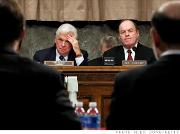
Committee Chairman Sen.
Christopher Dodd, D-Conn., (left) and
ranking member Sen. Richard
Shelby, R-Ala., (right) listen as
Federal Reserve Board Chairman
Ben Bernanke and Chairman of the
Securities and Exchange
Commission Christopher Cox testify
on Capitol Hill.
Christopher Dodd, D-Conn., (left) and
ranking member Sen. Richard
Shelby, R-Ala., (right) listen as
Federal Reserve Board Chairman
Ben Bernanke and Chairman of the
Securities and Exchange
Commission Christopher Cox testify
on Capitol Hill.
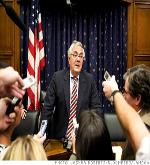
Reporters interviewed House
Financial Services Committee
chairman Rep. Barney Frank,
D-Mass., Wednesday after
Treasury Secretary Henry
Paulson and Federal Reserve
chairman Ben Bernanke were
grilled about the rescue plan.
Financial Services Committee
chairman Rep. Barney Frank,
D-Mass., Wednesday after
Treasury Secretary Henry
Paulson and Federal Reserve
chairman Ben Bernanke were
grilled about the rescue plan.
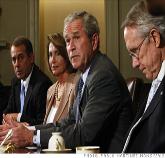
President Bush met with
congressional leaders at the White
House Thursday, including House
Minority Leader John Boehner,
R-Ohio (left), Speaker of the
House Rep. Nancy Pelosi,
D-Calif., and Senate Majority
Leader Sen. Harry Reid, D-Nev, to
discuss the proposed bailout.
congressional leaders at the White
House Thursday, including House
Minority Leader John Boehner,
R-Ohio (left), Speaker of the
House Rep. Nancy Pelosi,
D-Calif., and Senate Majority
Leader Sen. Harry Reid, D-Nev, to
discuss the proposed bailout.
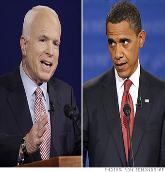
Sen. John McCain, R-Ariz. and
Sen. Barack Obama, D-Ill.,
squared off in the first presidential
debate Friday night, where the
economy was front and center.
Sen. Barack Obama, D-Ill.,
squared off in the first presidential
debate Friday night, where the
economy was front and center.

Speaker of the House Nancy
Pelosi, D-Calif., Secretary of
the Treasury Henry Paulson,
right, Senate Majority Leader
Harry Reid, D-Nev., left,
announce a tentative deal on
legislation regarding the
financial crisis.
Pelosi, D-Calif., Secretary of
the Treasury Henry Paulson,
right, Senate Majority Leader
Harry Reid, D-Nev., left,
announce a tentative deal on
legislation regarding the
financial crisis.

(L-R) House Financial Services
Committee Chairman Barney
Frank D-MA, Senate Majority
Leader Harry Reid D-NV, Speaker
of the House Nancy Pelosi D-CA,
and Senate Banking, Housing and
Urban Affairs Committee
Chairman Christopher Dodd D-CT,
hold a news conference at the
U.S. Captiol September 28, 2008
in Washington, DC to announce
the final bailout agreement.
Committee Chairman Barney
Frank D-MA, Senate Majority
Leader Harry Reid D-NV, Speaker
of the House Nancy Pelosi D-CA,
and Senate Banking, Housing and
Urban Affairs Committee
Chairman Christopher Dodd D-CT,
hold a news conference at the
U.S. Captiol September 28, 2008
in Washington, DC to announce
the final bailout agreement.
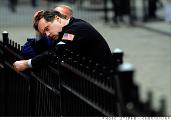
A trader takes a break as the Dow
Jones Industrial Average
plummets Monday, Sept. 29,
2008, in front of the New York
Stock Exchange in New York. The
was over 700 points the worst in
decades.
Jones Industrial Average
plummets Monday, Sept. 29,
2008, in front of the New York
Stock Exchange in New York. The
was over 700 points the worst in
decades.
KNOWLEDGEFINANCIAL.COM
A step by step guide to gaining control of your financial life.
Setting priorities
Here's help for the first -- and often the hardest -- step in achieving your financial goals: deciding which goals to pursue.
LESSON 2
Making a budget, saving money
How to bring your spending under control, so that you get the most out of every dollar.
LESSON 3
Basics of banking and saving
Here's how to get the best banking services at the best price, either online or off.
LESSON 4
Basics of investing
An introduction to making money in stocks, bonds and mutual funds REIT'S, real estate.
LESSON 5
Investing in stocks
The market can be a great place to turn savings into wealth -- or to lose your shirt. Here are some fundamentals of investing wisely.
LESSON 6
Investing in mutual funds
It's a mutual-fund jungle out there. Here's how to create a simple portfolio that works.
LESSON 7
Investing in bonds
Bonds can provide a steady and reasonably secure income, while adding ballast to your portfolio--but only if you really understand what you're buying.
LESSON 8
Buying a home
Owning your home is part of the American Dream, but if you’re not prepared, buying it can be a nightmare. Here are some fundamentals for buyers and sellers.
LESSON 9
Controlling debt
You've got to know when to hold debt--and when to fold it. This lesson shows you how to accomplish your financial goals by making debt work for you.
LESSON 10
Home Selling
WAYS TO SELL A PROPERTY FAST AND EASY FOR THE TOP PRICE!
Selling a home is a big decision and requires a lot of work. From getting the house ready to reviewing the escrow papers, our helpful guide will walk you through the
process of selling your home.
LESSON 11
INSURANCE
Health Insurance, Life Insurance, Home Insurance, Car Insurance
Great things to know about insurance
Buying a car, Auto loans. Great things to know:
Buying a car is like no other shopping experience. The choices seem to be endless. This lesson helps you sort through your options.
FINANCIAL FREEDOM: A SMARTEST WAY TO PREPARE A BETTER FUTURE. YOUR PATH TO WEALTH STARTS RIGHT NOW.
It's a fact: today, anyone can become a millionaire
– In the history of the world, there has never been
a better time to create wealth than right here, right
now in real estate.
Setting priorities
Here's help for the first -- and often the hardest -- step in achieving your financial goals: deciding which goals to pursue.
LESSON 2
Making a budget, saving money
How to bring your spending under control, so that you get the most out of every dollar.
LESSON 3
Basics of banking and saving
Here's how to get the best banking services at the best price, either online or off.
LESSON 4
Basics of investing
An introduction to making money in stocks, bonds and mutual funds REIT'S, real estate.
LESSON 5
Investing in stocks
The market can be a great place to turn savings into wealth -- or to lose your shirt. Here are some fundamentals of investing wisely.
LESSON 6
Investing in mutual funds
It's a mutual-fund jungle out there. Here's how to create a simple portfolio that works.
LESSON 7
Investing in bonds
Bonds can provide a steady and reasonably secure income, while adding ballast to your portfolio--but only if you really understand what you're buying.
LESSON 8
Buying a home
Owning your home is part of the American Dream, but if you’re not prepared, buying it can be a nightmare. Here are some fundamentals for buyers and sellers.
LESSON 9
Controlling debt
You've got to know when to hold debt--and when to fold it. This lesson shows you how to accomplish your financial goals by making debt work for you.
LESSON 10
Home Selling
WAYS TO SELL A PROPERTY FAST AND EASY FOR THE TOP PRICE!
Selling a home is a big decision and requires a lot of work. From getting the house ready to reviewing the escrow papers, our helpful guide will walk you through the
process of selling your home.
LESSON 11
INSURANCE
Health Insurance, Life Insurance, Home Insurance, Car Insurance
Great things to know about insurance
Buying a car, Auto loans. Great things to know:
Buying a car is like no other shopping experience. The choices seem to be endless. This lesson helps you sort through your options.
FINANCIAL FREEDOM: A SMARTEST WAY TO PREPARE A BETTER FUTURE. YOUR PATH TO WEALTH STARTS RIGHT NOW.
It's a fact: today, anyone can become a millionaire
– In the history of the world, there has never been
a better time to create wealth than right here, right
now in real estate.
 |  |  |  |  |  |  |  |
 |  |  |  |  |  |  |  |
 |  |  |  |  |  |  |
 |  |  |  |  |  |  |  |
CLICK HERE TO CONTINUE : THE 16 DAYS THAT SHOOCK THE US ECONOMY IN SEPTEMBER,
2008. AMERICA’S MONEY CRISIS / Bailout 101: What new law says
Here's a rundown of key provisions of the financial rescue plan that United State Senate voted,
Wednesday October 1; and the house voted Friday October 3, 2008.
2008. AMERICA’S MONEY CRISIS / Bailout 101: What new law says
Here's a rundown of key provisions of the financial rescue plan that United State Senate voted,
Wednesday October 1; and the house voted Friday October 3, 2008.
FIRST TIME HOME BUYERS,
NOW IT'S A GOOD TIME FOR
YOU TO BUY, MANY
PROGRAMS ARE AVAILABLE
TO HELP YOU.
CALL US AT 786-709-6577
SOUTH FLORIDA. WE'RE HERE
TO GUIDE YOU, AND TO INFORM
YOU.
REAL ESTATE FINANCING,
MORTGAGE AND LOANS, HOME
REFINANCING, HOME EQUITY,
REVERSE MORTGAGE.
WE'RE COMPETENT, LOYAL,
AND WE'VE ALL THE
EXPERIENCE NECESSARY TO
HELP YOU
NOW IT'S A GOOD TIME FOR
YOU TO BUY, MANY
PROGRAMS ARE AVAILABLE
TO HELP YOU.
CALL US AT 786-709-6577
SOUTH FLORIDA. WE'RE HERE
TO GUIDE YOU, AND TO INFORM
YOU.
REAL ESTATE FINANCING,
MORTGAGE AND LOANS, HOME
REFINANCING, HOME EQUITY,
REVERSE MORTGAGE.
WE'RE COMPETENT, LOYAL,
AND WE'VE ALL THE
EXPERIENCE NECESSARY TO
HELP YOU
| YOU NEED TO BUY OR LEASE A PROPERTY IN SOUTH FL. PLEASE, CONTACT US AT: 786-709-6577 COMMERCIAL, RESIDENTIAL, OR MOBIL HOME FINANCIAL HELP IS AVAILABLE! FREE CREDIT REPAIR HELP FOR PROSPECT! |
| YOU’VE PROPERTY FOR SALE? COMMERCIAL, RESIDENTIAL WE’LL BUY IT FROM YOU OR WE’LL SELL IT FOR YOU; FAST, QUICK & FOR THE TOP PRICE! SOUTH FLORIDA PLEASE CONTACT US… 786-709-6577 |
| --FREE SCHOLARSHIP FOR SCHOOL-- ''FREE GOVERNMENT GRANTS MONEY FOR SCHOOL-- --LOW INTEREST RATE LOANS FROM THE NATION LARGEST SOURCES OF LOCAL, NATIONAL, SPECIFIC SCHOLARSHIP AMERICAN DOLLAR. What are the letters, numers, and symbols, the latin words, the glowing eyes mean? BUILDING WEALTH RICH GUIDE: WHY AREN'T YOU RICH? BUILDING FINANCIAL WEALTH, OBTAIN FINANCIAL FREEDOM, BECOME A RICH PERSON; YES YOU CAN... Learn More! Financial Education - Financial Knowledge Everything You Need To Know About Finance. Dubai- The World Largest, Biggest, Tallest, Greatest of Almost Everything. Learn more about this magnificent place and as well as other countries. COPYRIGHT-- What is Copyright? The Basics About Copyright Registration. The procedure for copyright registration. Do I need copyright protection? How do I register? Learn More! ''AUTO LOANS: Great Car, Great Price…. but what about the Financing? Explore your financing options! Five Tips for Getting the Best Deal On a Car... AUTO DEALERSHIP: 5 Car Dealer Extras You May Not Need, Or You Don't Need... Before buying a car; learn this first... ..News Letter: Tax Saving Business News, financial news, the world market. ..Biography & History of the world greatest personalities & politicians,, ..The world worst natural disasters & earthquakes in the history of humanity,, .Inventions. Great Inventions and discoveries of the century,, What are they? .. HAITI: Things you don't know & what you must know. Learn More!,, ..Life Insurance Advantages, Benefits, & Features While Alive and After Death... Learn More Here! ..Insurance General Information: Ways to Make Money & Save Money on Your Insurance. Learn More... ..Term Insurance Advantages, Term Insurance General Knowledge. Buy the Term, and invest the difference. Learn More... ...Investment Products: Investing & Money Management Basics. FINANCIAL SOLUTIONS, TOOLS & RESOURCES. LEARN MORE... Insurance Products: How to make profits with the insurance companies? Learn More... |
| ..Life Insurance Advantages, Benefits, & Features While Alive and After Death... Learn More Here! ..Insurance General Information: Ways to Make Money & Save Money on Your Insurance. Learn More... ..Term Insurance Advantages, Term Insurance General Knowledge. Buy the Term, and invest the difference. Learn More... ..Life Insurance Quote. Find out if You Pay too much for Your Insurance, Or Check How Much You Can Pay For a Life Insurance... ..Investment Products: Investing & Money Management Basics. FINANCIAL SOLUTIONS, TOOLS & RESOURCES. LEARN MORE... Insurance Products: How to make profits with the insurance companies? Learn More. ..Five Insurance Policies Everyone Should Have Protecting your most important assets is an important step in creating a solid personal financial plan. The right insurance policies will go a long way toward helping you safeguard your earning power and your possessions THE IMPORTANCE OF INSURANCE IN SOMEONE'S LIFE! Your Financial Plan; Insurance is an important element of any sound financial plan Different types of insurance protect you and your loved ones in different ways against the cost of accidents, illness, disability, and death. INSURANCE KNOWLEDGE LIFE INSURANCE ADVANTAGES, FEATURES AND BENEFITS WHILE ALIVE AND AFTER DEATH. INSURANCE GENERAL KNOWLEDGE, GLOBAL INSURANCE INFORMATION FOR BETTER CHOICES, BETTER DECISION, BETTER GUARANTEE AND BETTER SATISFACTION. LEARN MORE HERE... ..HOW TO OBTAIN AN INSURANCE LICENSE, AND GET HIRED, START WORKING IMMEDIATELY WITH ONE OF THE GREATEST INSURANCE COMPANY IN THE WORLD? FREE INSURANCE SCHOOL, FREE COURSE, FREE TRAINING, FREE FINGERPRINT, FREE BOOKS FOR THOSE WHO LIVE IN MIAMI DADE AND BROWARD COUNTY FLORIDA. LEARN MORE HERE... Life Insurance Life insurance, payable when you die, can provide a surviving spouse, children, and other dependents with the funds necessary to maintain their standards of living, can help repay debt, and can fund education tuition costs. LIFE INSURANCE QUOTE. LEARN MORE.. the least amount of coverage, and vice versa. Ways to Reduce Your Life Insurance Premium While you can't do anything about two of the three main factors affecting your insurance premium (age and family medical history), there are steps you can take regarding the third - lifestyle. You could lower your insurance premium if you: |
| FREE FINANCIAL ADVICE. WAYS TO SAVE MONEY, MAKE MONEY, AND GET OUT OF DEBT! PERSONAL FINANCE. What are you doing with your money in the wake of the financial crisis? --- Where is the safe place to put money? My personal finance! FINANCIAL FREEDOM: A SMARTEST WAY TO PREPARE A BETTER FUTURE. Money-Making Information You'll Need to Succeed US ECONOMY, THE FINANCIAL SYSTEM, THE CREDIT MARKET. WHAT'S GOING? MONEY MANAGEMENT. Ten Resolutions to Make Your Financial Life Easier FINANCE: THE BANKING AND THE AMERICAN FINANCIAL SYSTEM HISTORY, SUCCESS AND FAILURE SAVING MONEY: THE SECRETS OF SAVING; WAYS TO SAVE A LOT OF MONEY AND GETTING RICHER IRA / INDIVIDUAL RETIREMENT ACCOUNT. What is an IRA? And what does it matter? SOCIAL SECURITY; THE ULTIMATE RETIREMENT GUIDE. HOW DOES SOCIAL SECURITY WORK? FINANCIAL REPORT: How to bring your spending under control, so that you get the most out of every dollar. 8 Reasons to get pre-qualified for a mortgage loan! ESTATE PLANNING: Estate planning, is it really the process of accumulating and disposing of an estate to maximize the goals of the estate owner to avoid probate, to lower the tax? Assets Protection: Don't Get Sued: Five Tips To Protect Your Company! Types of Asset-Protection Vehicles; Many different strategies have been developed over the years claiming to protect assets. How to protect yourself from...? BUILDING WEALTH! How to Become Wealthy? Nine Truths That Can Set You on the Path to Financial Freedom FINANCIAL KNOWLEDGE: The Successful Investment Journey, Ten Tips For The Successful Long-Term Investor FINANCIAL SYSTEM: AMERICA’S MONEY CRISIS / Bailout 101. LEARN ABOUT: Top 6 Biggest U.S. Government Financial Bailouts In History! 2-LEARN ABOUT MARKET CRASHES HISTORY. HOW AND WHEN? 3-LEARN ABOUT: THE UNITED STATE, AND THE WORLD MOST IMPORTANT FINANCIAL INSTITUTIONS! 4-LEARN ABOUT THE COMPLETE FINANCIAL TURMOIL, THE CREDIT CRISIS! BANKING & FINANCE / Knowledge Financial.com; an educational, a life changing website with great ideas of small business, with important things to know about our economy, and investment INVESTMENT: MAKE YOURSELF RICHER BY INVESTING THE RIGHT WAY IN THE RIGHT PRODUCTS. REAL ESTATE INVESTMENTS CAN HELP STOCK MARKET: STOCK MARKET A WAY TO INVEST AND MULTIPLY YOUR PROFITS. THESE INDUSTRIES HAS THOUSANDS OF COMPANIES TO BUY STOCKS FROM. FOREX MARKET: THE LARGEST MARKET IN THE WORLD TO INVEST AND GET RICHER IF YOU USE THE RIGHT TOOL. TAX CERTIFICATES: / TAX DEED: A BETTER WAY TO INVEST MONEY AND GET RICHER. TAX LIENS: How Can You Safely Earn 18% to 240% Per Year On Your Investments? Yes you can... By investing in Government Issued Tax Liens, Tax deed, Tax Certificates. |
| Internet Blogs The Most Interesting Blog On The Web, The Most Educative, Most Instructive blogs. ''Blog about Real estate investments: What everyone should know about the real estate market. How to find financing '' http://knowledgefinancial.blogspot.com/ ''Blog about Insurance: What exactly you should find out about your insurance company, policy and plan.'' http://www.buyheremarket.blogspot.com/ ''Blog about financial education, financial knowledge, financial literacy: Economy-business-finance-investing'' http://www.buyheremarket.blogspot.com/ ''''..Social Security Benefits: 12 Things You Must to Know About.-- ' |
Banking services that will be obsolete in about 10 to 15 years
Bank branches and bank tellers
A decrease in physical bank branches over the next decade is plausible given the recent frenzied introduction of new
technology to financial transactions and the changing customer demographics. Local bank branches are staffed by bank tellers
who, although they are the consumer-friendly public faces of the financial institutions, could quickly be on their way out as well
The number of teller jobs is expected to decline, according to Bureau of Labor Statistics, U.S. Department of Labor, Occupational
Outlook Handbook, 2016-17 Edition. Specifically, the 10-year outlook from 2014 to 2024 is that employment of tellers will decline
by 8 percent.
“The digital transformation of society is driving a significant change to enterprises of all types — including banks — to ensure
that they adapt to the evolving preferences of their current and future users,”
Bank branches and bank tellers
A decrease in physical bank branches over the next decade is plausible given the recent frenzied introduction of new
technology to financial transactions and the changing customer demographics. Local bank branches are staffed by bank tellers
who, although they are the consumer-friendly public faces of the financial institutions, could quickly be on their way out as well
The number of teller jobs is expected to decline, according to Bureau of Labor Statistics, U.S. Department of Labor, Occupational
Outlook Handbook, 2016-17 Edition. Specifically, the 10-year outlook from 2014 to 2024 is that employment of tellers will decline
by 8 percent.
“The digital transformation of society is driving a significant change to enterprises of all types — including banks — to ensure
that they adapt to the evolving preferences of their current and future users,”
CHECKS - BANK STATEMENTS
For decades, people paid their bills with paper checks, whether in person at the grocery store or by mail to the electric company.
Commercial banks mailed monthly paper statements to customers with checking accounts, as well, before gradually offering
customers the option to obtain account information via phone.
The next step in the financial services evolution was online banking and, more recently, mobile banking. You can now view all of
your banking statements, and current account balances, online or from your phone no matter where you are.
Although you can still get paper checking account statements, many banks such as ...
Some banks will continue to provide them for while but only if you pay a fee, which might be $5 per statement. In addition, your
paper statement previously included the physical checks that you wrote during the monthly period.
Now, even if you receive statements in the mail, most banks do not send the canceled checks. You can get copies from your
bank, but they might charge a fee. So, it’s inevitable that banks will phase out the use of all paper items altogether before long.
-------------------
CASH
This one might be hard to believe, but a whopping 62 percent of Americans think the U.S. will be a cashless society within their
lifetime, according to a 2016 Gallup poll. Services such as PayPal’s Venmo app, Apple Pay and Square Cash facilitate real-time
money transfers between people using a mobile app. And big banks like Chase, Wells Fargo, Bank of America and U.S. Bank are
elbowing each other to get into the person-to-person payment funds transfer market also, reported the New York Times.
The use of papers bills and coins might decrease over the next 10 years, although it’s hard to imagine that hard currency will
disappear completely. Who knows, maybe even gumball machines will start to take mobile payments, too — or at least credit
cards.
--------------
As we increasingly become a cashless society, ATMs will likely become extinct as well. Debit cards are the current method of
access to ATMs, but customers already use their smartphones rather than machines to deposit paper checks — while they still
exist.
“I believe that the debit card will become a piece of financial services history within the next eight to ten years,” said Patricia
Hewitt, a strategic advisor to the payment industry. “Replacing it will be applications that transfer depository funds on an as-
needed basis in real or near-real time.” In fact, Hewitt predicted there will be little need for services such as ATMs because most
cash transactions will be handled using apps.
Other financial industry experts also anticipated the demise of debit cards and PINs, particularly due to fraud concerns. “A static
PIN can be stolen and reused, and cards can be cloned easily by fraudsters,” said Shane Stevens, director of omni-channel
identity and trust solutions at VASCO Data Security International, Inc., a company that provides two-factor authentication and
digital signature solutions to financial institutions.
For decades, people paid their bills with paper checks, whether in person at the grocery store or by mail to the electric company.
Commercial banks mailed monthly paper statements to customers with checking accounts, as well, before gradually offering
customers the option to obtain account information via phone.
The next step in the financial services evolution was online banking and, more recently, mobile banking. You can now view all of
your banking statements, and current account balances, online or from your phone no matter where you are.
Although you can still get paper checking account statements, many banks such as ...
Some banks will continue to provide them for while but only if you pay a fee, which might be $5 per statement. In addition, your
paper statement previously included the physical checks that you wrote during the monthly period.
Now, even if you receive statements in the mail, most banks do not send the canceled checks. You can get copies from your
bank, but they might charge a fee. So, it’s inevitable that banks will phase out the use of all paper items altogether before long.
-------------------
CASH
This one might be hard to believe, but a whopping 62 percent of Americans think the U.S. will be a cashless society within their
lifetime, according to a 2016 Gallup poll. Services such as PayPal’s Venmo app, Apple Pay and Square Cash facilitate real-time
money transfers between people using a mobile app. And big banks like Chase, Wells Fargo, Bank of America and U.S. Bank are
elbowing each other to get into the person-to-person payment funds transfer market also, reported the New York Times.
The use of papers bills and coins might decrease over the next 10 years, although it’s hard to imagine that hard currency will
disappear completely. Who knows, maybe even gumball machines will start to take mobile payments, too — or at least credit
cards.
--------------
As we increasingly become a cashless society, ATMs will likely become extinct as well. Debit cards are the current method of
access to ATMs, but customers already use their smartphones rather than machines to deposit paper checks — while they still
exist.
“I believe that the debit card will become a piece of financial services history within the next eight to ten years,” said Patricia
Hewitt, a strategic advisor to the payment industry. “Replacing it will be applications that transfer depository funds on an as-
needed basis in real or near-real time.” In fact, Hewitt predicted there will be little need for services such as ATMs because most
cash transactions will be handled using apps.
Other financial industry experts also anticipated the demise of debit cards and PINs, particularly due to fraud concerns. “A static
PIN can be stolen and reused, and cards can be cloned easily by fraudsters,” said Shane Stevens, director of omni-channel
identity and trust solutions at VASCO Data Security International, Inc., a company that provides two-factor authentication and
digital signature solutions to financial institutions.
Secrets Big Banks Don't Want You To Know
Learn five secrets your bank doesn’t want you to know about.
1. Banks want you to walk in to their branches
When you walk into a branch, the teller seems delighted to see you, but don’t be fooled, there's more to it than that.
Tellers always seem to be pushing for you to open new accounts but that’s because their jobs depend on it. They are
salespeople and have quotas to meet.
Each new account you open means they will receive commission.
Tellers are also required to send a certain amount of customers to the personal bankers at their desk. The biggest commission
bankers receive is on large deposit accounts.
If you have questions, call customer service. They might try and upsell you too, but it’s usually easier saying no over the phone
than when you’re face-to-face with the person.
2. The more you swipe, the more they make
Every time you swipe your card, whether it’s debit or credit, the bank is making money from charging the merchant certain fees.
Promotional credit card offers will often want you to spend a certain amount within a time frame in order to be rewarded.
Although it's a great deal for you, they are doing that for their benefit. The more you spend swiping your card, the quicker the
banks make their money back from “rewarding” you.
Also, banks are counting on the fact that once you’ve racked up the $1,000, you won’t be able to pay it all off in one month,
creating interest fees.
3. A closed checking account can come back to haunt you
When you close a checking account you assume that’s it.
Well, that may not be the case. There have been instances in which customers closed their checking account, but forgot to
switch over their autopay transactions, which caused their “closed” account to be charged anyway.
This resulted in customers having to pay fees, penalties and in some cases were even turned over to collection agencies.
Bank of America eventually changed their policy due to the complaints, but not all banks have taken such measures.
4. There may be a way to avoid checking account fees
A lot of big name-banks charge a monthly fee for your checking account if you don’t maintain a minimum balance.
When you receive money via direct deposit from a company or the government, it is sent through an electronic network, or
Automated Clearing House (ACH).
Some banks however, categorize those payments and all other bank transfers as “PPD” (prearranged payment and deposits). If
this is the case with your bank then you can deposit money from PayPal, online savings, or another accounts.
When you check your bank statements and it says "PPD," next to your deposit. If so, this will fulfill the requirement for direct
deposit, waiving your monthly fee.
5. The Universal Default Clause
This is a clause applies to bank-issued credit cards. It states the bank is allowed to browse through all
of your open credit accounts and if you’ve paid any of them late, they have the right to raise the interest rate on its card, or
even worse, cancel it.
Back in 2010, the CARD Act was supposed to get rid of this universal default clause, however, the provisions remain that the
interest rate can’t be raised on existing balances unless you are 60 days late with your payment.
You should avoid opening a bank-issued card that has this clause. There are plenty
out there that don’t, such as the Capital One VentureOne Rewards card. Make sure to do your research before you commit to a
card.
To avoid this from happening to you, do your research when opening or closing a new account and specifically ask the bank
what it means when you close your account.
Learn five secrets your bank doesn’t want you to know about.
1. Banks want you to walk in to their branches
When you walk into a branch, the teller seems delighted to see you, but don’t be fooled, there's more to it than that.
Tellers always seem to be pushing for you to open new accounts but that’s because their jobs depend on it. They are
salespeople and have quotas to meet.
Each new account you open means they will receive commission.
Tellers are also required to send a certain amount of customers to the personal bankers at their desk. The biggest commission
bankers receive is on large deposit accounts.
If you have questions, call customer service. They might try and upsell you too, but it’s usually easier saying no over the phone
than when you’re face-to-face with the person.
2. The more you swipe, the more they make
Every time you swipe your card, whether it’s debit or credit, the bank is making money from charging the merchant certain fees.
Promotional credit card offers will often want you to spend a certain amount within a time frame in order to be rewarded.
Although it's a great deal for you, they are doing that for their benefit. The more you spend swiping your card, the quicker the
banks make their money back from “rewarding” you.
Also, banks are counting on the fact that once you’ve racked up the $1,000, you won’t be able to pay it all off in one month,
creating interest fees.
3. A closed checking account can come back to haunt you
When you close a checking account you assume that’s it.
Well, that may not be the case. There have been instances in which customers closed their checking account, but forgot to
switch over their autopay transactions, which caused their “closed” account to be charged anyway.
This resulted in customers having to pay fees, penalties and in some cases were even turned over to collection agencies.
Bank of America eventually changed their policy due to the complaints, but not all banks have taken such measures.
4. There may be a way to avoid checking account fees
A lot of big name-banks charge a monthly fee for your checking account if you don’t maintain a minimum balance.
When you receive money via direct deposit from a company or the government, it is sent through an electronic network, or
Automated Clearing House (ACH).
Some banks however, categorize those payments and all other bank transfers as “PPD” (prearranged payment and deposits). If
this is the case with your bank then you can deposit money from PayPal, online savings, or another accounts.
When you check your bank statements and it says "PPD," next to your deposit. If so, this will fulfill the requirement for direct
deposit, waiving your monthly fee.
5. The Universal Default Clause
This is a clause applies to bank-issued credit cards. It states the bank is allowed to browse through all
of your open credit accounts and if you’ve paid any of them late, they have the right to raise the interest rate on its card, or
even worse, cancel it.
Back in 2010, the CARD Act was supposed to get rid of this universal default clause, however, the provisions remain that the
interest rate can’t be raised on existing balances unless you are 60 days late with your payment.
You should avoid opening a bank-issued card that has this clause. There are plenty
out there that don’t, such as the Capital One VentureOne Rewards card. Make sure to do your research before you commit to a
card.
To avoid this from happening to you, do your research when opening or closing a new account and specifically ask the bank
what it means when you close your account.
Here’s What Banks Don’t Want You to Know
#1. Banks can take money from your account without asking.
A “right of setoff ” is one of the biggest banking secrets on the list that can pummel your finances to the ground. It often occurs
when you have a deposit account and a loan at the same bank.
Also referred to as a banker’s lien, a right of setoff grants the bank the right to access funds in your deposit account
automatically and without notice if you default on your loan.
It mightseem ridiculous that banks have the power of setoff, but it actually makes sense. When you
deposit money in the bank, you are essentially lending money to your bank with the promise they’ll pay you back when you ask
for it (see How Do Banks Make Money? for more on that). Upon taking on a loan — whether an auto loan, personal loan or
mortgage loan — you’ve established a mutual debtor-creditor relationship.
Why should the bank pay you back your money (. your deposited funds), if you can’t make good on your promise to repay them?
It is very likely that your loan’s terms and conditions identify this stipulation in fine print.
The best thing to do to avoid a right of setoff is to make timely payments toward the loan — avoiding default is the only 100
percent guarantee that you won’t lose money via a setoff.
If you’re still concerned about your money, transfer your funds to a third-party bank. Setoffs only apply to deposit accounts
within the same institution that funds your loan; in transferring your money, the bank cannot automatically withdraw your money,
and will instead have to seek out legal action to claim your funds.
#2. You can negotiate credit card rates.
Credit card rates vary greatly between creditors — some offer introductory rates as low as 0% APR while others soar past 20%.
Plus, many credit card companies offer alluring incentives to win your business, like rewards programs, frequent flyer miles or
cash back.
Let’s say you’re faced with two competing credit card offers — one with a low interest rate of 10%, and one that offers rewards
points with a slightly higher interest rate. Call the card company with the rewards program.
When speaking to the representative, make sure your tone is indifferent. Explain that you’re on the fence about applying for
their credit card, because you received a better offer from their competitor at a drastically lower interest rate. The service
representative will likely tout the rewards program, but stay firm — yet courteous — in focusing on lowering the credit card rate.
I played out a similar scenario with my own credit card company. After only five minutes of conversation, the initial 19.99% APR
offer I received in the mail dropped to 12.99% APR. The call took all of seven minutes (I was on hold for about two minutes), but
the savings were well worth it.
#3. Bank fees are also negotiable.
The 2012 World Retail Banking Report survey found that 62 percent of U.S. consumers do not plan on leaving their bank anytime
soon, but that doesn’t mean banks can get away with just anything. Fifty percent of respondents surveyed said that bank fees
would prompt them to switch to another bank — the second highest trigger cited in the report.
It’s for this reason that bank fees, even if you are in the wrong, are just as negotiable as credit card rates.
Did you miscalculate how much money you had in your checking account, and write out a bounced check? Call your bank
immediately to contest the charge. By contest, I don’t mean deny it, rather, plea your case to have a bounced check or overdraft
fee removed by leveraging your loyalty to the bank.
Note your years of devoted business with the bank, itemize all your accounts (i.e. checking and savings account, car loans,
mortgage loan, etc.) you’ve kept with the institution and highlight your good record with the bank (assuming you haven’t
defaulted and the fee you’re asking to remove is a first-time offense). The most important part is not to let up — stay polite and
don’t take no for an answer.
What banks don’t want you to know is that most institutions will gladly waive a $25 overdraft fee if it means keeping your
business.
#4. Debit cards carry higher liability.
When standing at the checkout counter, you’ll often hear the cashier ask, “credit or debit?” when you have your Visa or
MasterCard debit card in hand. While the debit option gives you the convenience to see the transaction process almost
immediately, you’re putting yourself at greater risk.
Credit cards and debit cards have differing liabilities associated with them.
By choosing the credit option and signing for your purchase, you are protecting yourself from fraudulent activity under Visa or
MasterCards liability terms. With credit card fraud, your maximum liability under federal law is $50, according to the Federal
Trade Commission. And in most circumstances, like with a Visa transaction, you’ll have zero liability on unauthorized charges.
Debit cards are another story, however. When you encounter fraudulent activity with debit cards, timing is essential in
determining the maximum out-of-pocket liability you’re responsible for covering. Your ultimate liability depends on your unique
situation, but if you’ve lost your debit card you have to report it lost within two business days to limit your liability to $50. But
reporting a lost or stolen debit card, or contesting fraudulent charges beyond two days, may hold you liable for a maximum of
$500.
Whenever possible, opt for a credit card purchases to limit the financial blow, in the event of fraud.
#5. Bank tellers are not financial experts.
Bank tellers are your first point of contact with your bank, but what banks don’t want you to know is that many of them don’t
have a financial background of any kind. You’d expect that the person managing your transactions is finely attuned to the ins
and outs of handling financial accounts, but that’s usually not the case.
While some bank tellers may indeed have some financial knowledge, most are straight out of high school or are still college
students.
Upon taking on the position, Gilpin shares that the requirements were “very minimal,” essentially those who were simply able to
learn as they go and acknowledge customers at the window were brought onto the team.
“Did I meet those requirements? Yes,” said Gilpin, “But are those really the right requirements for being the first line of contact
for a person’s financial affairs, questions, and concerns? Of course not.” Fortunately for Gilpin, she has since continued on to
work in the financial services industry for over 20 years.
According to the 2012 World Retail Banking Report survey, the number one cause for switching to a new
bank, at 53 percent of responses, is poor customer service. If you’re not getting the response or answers you’re looking for
from a bank teller, move up the ranks and speak to a supervisor or branch manager.
Likely, an unsatisfactory service experience can get you additional benefits like added rewards points onto a bank credit card
or a reimbursement on a statement.
The truth about ‘banks’ and ‘money’ shall set you free.”
The banks commit fraud every single day, and most people haven’t got a clue!
Our government has signed us all up to be slaves, and yet most people still
believe that they are free.
#1. Banks can take money from your account without asking.
A “right of setoff ” is one of the biggest banking secrets on the list that can pummel your finances to the ground. It often occurs
when you have a deposit account and a loan at the same bank.
Also referred to as a banker’s lien, a right of setoff grants the bank the right to access funds in your deposit account
automatically and without notice if you default on your loan.
It mightseem ridiculous that banks have the power of setoff, but it actually makes sense. When you
deposit money in the bank, you are essentially lending money to your bank with the promise they’ll pay you back when you ask
for it (see How Do Banks Make Money? for more on that). Upon taking on a loan — whether an auto loan, personal loan or
mortgage loan — you’ve established a mutual debtor-creditor relationship.
Why should the bank pay you back your money (. your deposited funds), if you can’t make good on your promise to repay them?
It is very likely that your loan’s terms and conditions identify this stipulation in fine print.
The best thing to do to avoid a right of setoff is to make timely payments toward the loan — avoiding default is the only 100
percent guarantee that you won’t lose money via a setoff.
If you’re still concerned about your money, transfer your funds to a third-party bank. Setoffs only apply to deposit accounts
within the same institution that funds your loan; in transferring your money, the bank cannot automatically withdraw your money,
and will instead have to seek out legal action to claim your funds.
#2. You can negotiate credit card rates.
Credit card rates vary greatly between creditors — some offer introductory rates as low as 0% APR while others soar past 20%.
Plus, many credit card companies offer alluring incentives to win your business, like rewards programs, frequent flyer miles or
cash back.
Let’s say you’re faced with two competing credit card offers — one with a low interest rate of 10%, and one that offers rewards
points with a slightly higher interest rate. Call the card company with the rewards program.
When speaking to the representative, make sure your tone is indifferent. Explain that you’re on the fence about applying for
their credit card, because you received a better offer from their competitor at a drastically lower interest rate. The service
representative will likely tout the rewards program, but stay firm — yet courteous — in focusing on lowering the credit card rate.
I played out a similar scenario with my own credit card company. After only five minutes of conversation, the initial 19.99% APR
offer I received in the mail dropped to 12.99% APR. The call took all of seven minutes (I was on hold for about two minutes), but
the savings were well worth it.
#3. Bank fees are also negotiable.
The 2012 World Retail Banking Report survey found that 62 percent of U.S. consumers do not plan on leaving their bank anytime
soon, but that doesn’t mean banks can get away with just anything. Fifty percent of respondents surveyed said that bank fees
would prompt them to switch to another bank — the second highest trigger cited in the report.
It’s for this reason that bank fees, even if you are in the wrong, are just as negotiable as credit card rates.
Did you miscalculate how much money you had in your checking account, and write out a bounced check? Call your bank
immediately to contest the charge. By contest, I don’t mean deny it, rather, plea your case to have a bounced check or overdraft
fee removed by leveraging your loyalty to the bank.
Note your years of devoted business with the bank, itemize all your accounts (i.e. checking and savings account, car loans,
mortgage loan, etc.) you’ve kept with the institution and highlight your good record with the bank (assuming you haven’t
defaulted and the fee you’re asking to remove is a first-time offense). The most important part is not to let up — stay polite and
don’t take no for an answer.
What banks don’t want you to know is that most institutions will gladly waive a $25 overdraft fee if it means keeping your
business.
#4. Debit cards carry higher liability.
When standing at the checkout counter, you’ll often hear the cashier ask, “credit or debit?” when you have your Visa or
MasterCard debit card in hand. While the debit option gives you the convenience to see the transaction process almost
immediately, you’re putting yourself at greater risk.
Credit cards and debit cards have differing liabilities associated with them.
By choosing the credit option and signing for your purchase, you are protecting yourself from fraudulent activity under Visa or
MasterCards liability terms. With credit card fraud, your maximum liability under federal law is $50, according to the Federal
Trade Commission. And in most circumstances, like with a Visa transaction, you’ll have zero liability on unauthorized charges.
Debit cards are another story, however. When you encounter fraudulent activity with debit cards, timing is essential in
determining the maximum out-of-pocket liability you’re responsible for covering. Your ultimate liability depends on your unique
situation, but if you’ve lost your debit card you have to report it lost within two business days to limit your liability to $50. But
reporting a lost or stolen debit card, or contesting fraudulent charges beyond two days, may hold you liable for a maximum of
$500.
Whenever possible, opt for a credit card purchases to limit the financial blow, in the event of fraud.
#5. Bank tellers are not financial experts.
Bank tellers are your first point of contact with your bank, but what banks don’t want you to know is that many of them don’t
have a financial background of any kind. You’d expect that the person managing your transactions is finely attuned to the ins
and outs of handling financial accounts, but that’s usually not the case.
While some bank tellers may indeed have some financial knowledge, most are straight out of high school or are still college
students.
Upon taking on the position, Gilpin shares that the requirements were “very minimal,” essentially those who were simply able to
learn as they go and acknowledge customers at the window were brought onto the team.
“Did I meet those requirements? Yes,” said Gilpin, “But are those really the right requirements for being the first line of contact
for a person’s financial affairs, questions, and concerns? Of course not.” Fortunately for Gilpin, she has since continued on to
work in the financial services industry for over 20 years.
According to the 2012 World Retail Banking Report survey, the number one cause for switching to a new
bank, at 53 percent of responses, is poor customer service. If you’re not getting the response or answers you’re looking for
from a bank teller, move up the ranks and speak to a supervisor or branch manager.
Likely, an unsatisfactory service experience can get you additional benefits like added rewards points onto a bank credit card
or a reimbursement on a statement.
The truth about ‘banks’ and ‘money’ shall set you free.”
The banks commit fraud every single day, and most people haven’t got a clue!
Our government has signed us all up to be slaves, and yet most people still
believe that they are free.
//'' Long-Term Care Insurance Blog - // Life Insurance Blog //- Health Care Insurance Blog - // Financial Knowledge Blog -
// Alliance Business Blog - //
// ' Mortgage & Loans Blog - // Career Opportunity Blog - // Real Estate Blog - // Financial Academy School Blog - //
Nursing Blog - //
// ' Millionaire's Blog - // World Class Service Blog - // Money Making Network's Blog - // Insurance Of America - // Alliance
Business Blog - //
// Alliance Business Blog - //
// ' Mortgage & Loans Blog - // Career Opportunity Blog - // Real Estate Blog - // Financial Academy School Blog - //
Nursing Blog - //
// ' Millionaire's Blog - // World Class Service Blog - // Money Making Network's Blog - // Insurance Of America - // Alliance
Business Blog - //
| '' Free Credit Report & Credit Score /-/ Money & Investing /-/ Business & Entrepreneurship /-/ Personal Finance'/-/ '' Assets & Wealth Management /-/ Insurance & Annuity / Banking & Finance /-/ '' Financial Market & Economy /-/ Currency Exchange & American Dollar /-/ Retirement Plans & Estate Planning /-/ '' Real Estate Market & Mortgage Loans /-/ Oil/Gas & Commodities /-/ Tax Liens Certificates & Tax Deeds // |
BLACKLISTED
Million Customers Are Blacklisted by Banks
million customers have been rejected for services because of black marks against their names in these databases, the Times
says. One thing that most blacklisted consumers have in common: They’re low-income.
These are not credit-scoring systems used to assess you for a credit card or mortgage. These are different databases, used
internally by banks. At least initially they were developed to fight fraud. But the databases have evolved, also, into a risk-
management tool that banks reportedly use to reject customers who might cost the bank more than their business is worth.
About 80 percent of the nation’s banks use information from the [ChexSystems] database to screen bank account applicants.
Most negative information on a person’s report stays in ChexSystems’ database for five years, according to ChexSystems.
When your name gets a black mark on one of these databases — for reasons ranging from too many overdrafts or bounced
checks to identity theft (one man told CNN that he was rejected after ID thieves drained his accounts, causing bank fees to pile
up) – suddenly life gets very difficult. Banks may shut you out from their services for up to seven years.
Bank accounts: A staple of modern life
Being shut out from the mainstream banking system is no small inconvenience. Bank accounts are a necessity of modern life.
Electronic payments — credit cards, debit cards and electronic bill payments — are rapidly replacing cash (and checks), and bank
alternatives — check-cashing companies, pawnbrokers and payday lenders — can be time-consuming and costly.
Department of Consumer Affairs:
“Hundreds of thousands of Americans are being shut out for relatively small mistakes,”
Try to clear your name
If you’ve been rejected by banks, the bitter truth is that you may not have many options. But there are some things you can do.
The Fair Credit Reporting Act requires a bank to disclose why it rejected your business. That doesn’t mean the explanations will
be clear or easy to understand, however. Make sure that, at the minimum, any information you get from the bank tells you the
name of the company that has flagged a problem.
Get that company to give you a copy of your report. Read it carefully, looking for errors. If not corrected,
negative information can remain for five years on the report. So you’ll want to dispute anything that’s incorrect. ChexSystems’
consumer assistance page, for example, explains how to file a dispute with that company. Consumers are entitled to one free
annual ChexSystems report.
In reality, consumer advocates and federal regulators told the Times, it can be difficult to get errors removed from your report –
or even to get a copy of your report in some cases. “Some databases … provide scant details of the reason for the negative
mark, according to a review of more [than] two dozen letters
Million Customers Are Blacklisted by Banks
million customers have been rejected for services because of black marks against their names in these databases, the Times
says. One thing that most blacklisted consumers have in common: They’re low-income.
These are not credit-scoring systems used to assess you for a credit card or mortgage. These are different databases, used
internally by banks. At least initially they were developed to fight fraud. But the databases have evolved, also, into a risk-
management tool that banks reportedly use to reject customers who might cost the bank more than their business is worth.
About 80 percent of the nation’s banks use information from the [ChexSystems] database to screen bank account applicants.
Most negative information on a person’s report stays in ChexSystems’ database for five years, according to ChexSystems.
When your name gets a black mark on one of these databases — for reasons ranging from too many overdrafts or bounced
checks to identity theft (one man told CNN that he was rejected after ID thieves drained his accounts, causing bank fees to pile
up) – suddenly life gets very difficult. Banks may shut you out from their services for up to seven years.
Bank accounts: A staple of modern life
Being shut out from the mainstream banking system is no small inconvenience. Bank accounts are a necessity of modern life.
Electronic payments — credit cards, debit cards and electronic bill payments — are rapidly replacing cash (and checks), and bank
alternatives — check-cashing companies, pawnbrokers and payday lenders — can be time-consuming and costly.
Department of Consumer Affairs:
“Hundreds of thousands of Americans are being shut out for relatively small mistakes,”
Try to clear your name
If you’ve been rejected by banks, the bitter truth is that you may not have many options. But there are some things you can do.
The Fair Credit Reporting Act requires a bank to disclose why it rejected your business. That doesn’t mean the explanations will
be clear or easy to understand, however. Make sure that, at the minimum, any information you get from the bank tells you the
name of the company that has flagged a problem.
Get that company to give you a copy of your report. Read it carefully, looking for errors. If not corrected,
negative information can remain for five years on the report. So you’ll want to dispute anything that’s incorrect. ChexSystems’
consumer assistance page, for example, explains how to file a dispute with that company. Consumers are entitled to one free
annual ChexSystems report.
In reality, consumer advocates and federal regulators told the Times, it can be difficult to get errors removed from your report –
or even to get a copy of your report in some cases. “Some databases … provide scant details of the reason for the negative
mark, according to a review of more [than] two dozen letters